Agentic AI changes how far an analysis can proceed without constant human direction.
An agent can take an initial business question, investigate several explanations, compare populations, and continue the analysis as new relationships emerge. For Decision Intelligence, this creates the possibility of investigating far more combinations of data and business conditions than a person or team could reasonably work through manually.
Claude makes this kind of multi-step analysis feasible because it can work across large amounts of information and continue an investigation without requiring a new instruction at each stage. With access to customer data, experiment results, internal documentation, and business rules, it can investigate a problem and present the result in a polished narrative, visualization, or dashboard.
As Claude takes on more of the analytical process, an important question emerges for Decision Intelligence: how much confidence should the business place in a recommendation when the AI has played a major role in deciding what to investigate, how to interpret the result, and how to present the conclusion?
Why Claude Changes the Analytical Process
Most sophisticated analytics already involves exploration. Analysts test different explanations, refine hypotheses and follow unexpected findings. Agentic AI changes the amount of that work that can happen autonomously and the speed at which the investigation can branch.
A pricing team, for example, might begin by asking why conversion has fallen after a change in promotional strategy. Claude could compare regions, customer types, product categories, previous purchasing behavior and discount levels. It could then investigate combinations that appear unusual and continue pursuing them without waiting for an analyst to specify each comparison.
That capability has obvious value. Important commercial relationships often sit below the aggregate numbers. They may exist within a small population, a particular combination of behaviors, or an interaction between variables that nobody initially considered relevant.
At the same time, AI is beginning to influence more than the calculation. It can affect how the problem is framed, which relationships receive attention and which findings are ultimately presented as important.
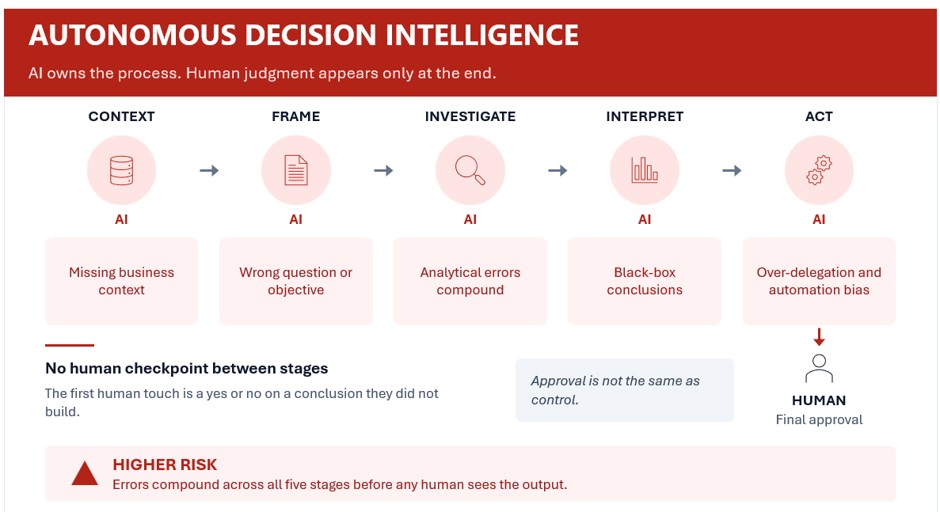
The figure follows the analytical process across Context, Frame, Investigate, Interpret and Act. As AI takes on a larger role across these stages, human judgment can become progressively further removed from the reasoning that produced the recommendation.
When that happens, a business can end up reviewing a recommendation without fully seeing the analytical choices that shaped it. This becomes especially important when the finding itself is technically sound, because the weakness may lie in how the result is interpreted rather than in the analysis itself.
The Harder Problem Begins With a Correct Finding
Consider a national retailer reviewing a 10% promotion on portable heaters. Claude identifies customers in the Midwest whose conversion rate was 15% higher during the promotion and recommends increasing promotional spend against similar customers.
The numbers are correct. But a major winter storm hit the region during the same period, sharply increasing demand for heaters. Increasing the discount could simply reduce margin on purchases customers were already likely to make.
Claude identified a real relationship in the data. The business question is whether the promotion caused the higher conversion and whether acting on the finding would create incremental value.
This is a central challenge in Decision Intelligence. AI can identify many statistically interesting relationships, but the business still has to determine which ones matter and why.
The Real Standard Should Be an Inspectable Analysis
Claude can work across large amounts of customer data, campaign history and internal documentation, but access to that information does not guarantee that the right business context will shape the analysis. A pricing team may prioritize margin in one category and volume in another. An experimentation team may use one metric as an early signal and another to make a rollout decision.
That is why the quality of the explanation is only part of the issue. The analysis itself needs to be inspectable.
In the heater example, an executive should be able to see how the Midwest population was defined, which period was analyzed, whether the effect existed before the storm and what happens when storm-related demand is removed.
The same standard applies when Claude identifies a customer segment, pricing opportunity or experiment result. A domain expert should be able to examine the relevant population, variables and evidence, and see whether changing an assumption materially changes the conclusion.
An explanation tells the executive why a recommendation appears reasonable. An inspectable analysis allows the business to test whether the evidence supports it. That also gives “human in the loop” a more meaningful role. Domain experts need to be able to challenge the analytical choices behind a recommendation, rather than simply approve the final output.
Where Klary Fits
This is the problem Klary is built to address. Klary combines agentic investigation with the business context and analytical structure required for Decision Intelligence. The people responsible for a decision can examine the populations and evidence behind a finding and challenge the analysis before acting on it.
This connects directly to Klary's work on context in Agentic Analytics: the relevant business context needs to shape both what the system investigates and how the result is interpreted.
As AI takes on more of the analytical process, the standard should be clear: a recommendation needs to be supported by an analysis the business can inspect, understand and challenge.