Agentic Analytics is supposed to do something traditional BI was not designed to do: not only answer the question asked, but help uncover questions and opportunities the business may have missed.
Interest in that capability is already broad, but scaled adoption remains limited. According to a recent McKinsey survey, 62% of respondents said their organizations were at least experimenting with AI agents, while no more than 10% were scaling them in any individual business function.
Some of that gap will narrow as models improve and the surrounding infrastructure matures. But technology is only part of the problem. An agent can identify a statistically valid pattern and still reach the wrong business conclusion if it does not understand what the data represents, which relationships are worth investigating, or how a finding should be interpreted.
That is the context problem in Agentic Analytics. Context is not simply a larger prompt or access to more corporate data. It is the business and domain knowledge required to move from a planning question to a useful answer. And it matters at three points in that process: preparing the data, analyzing what is worth investigating, and interpreting the result.
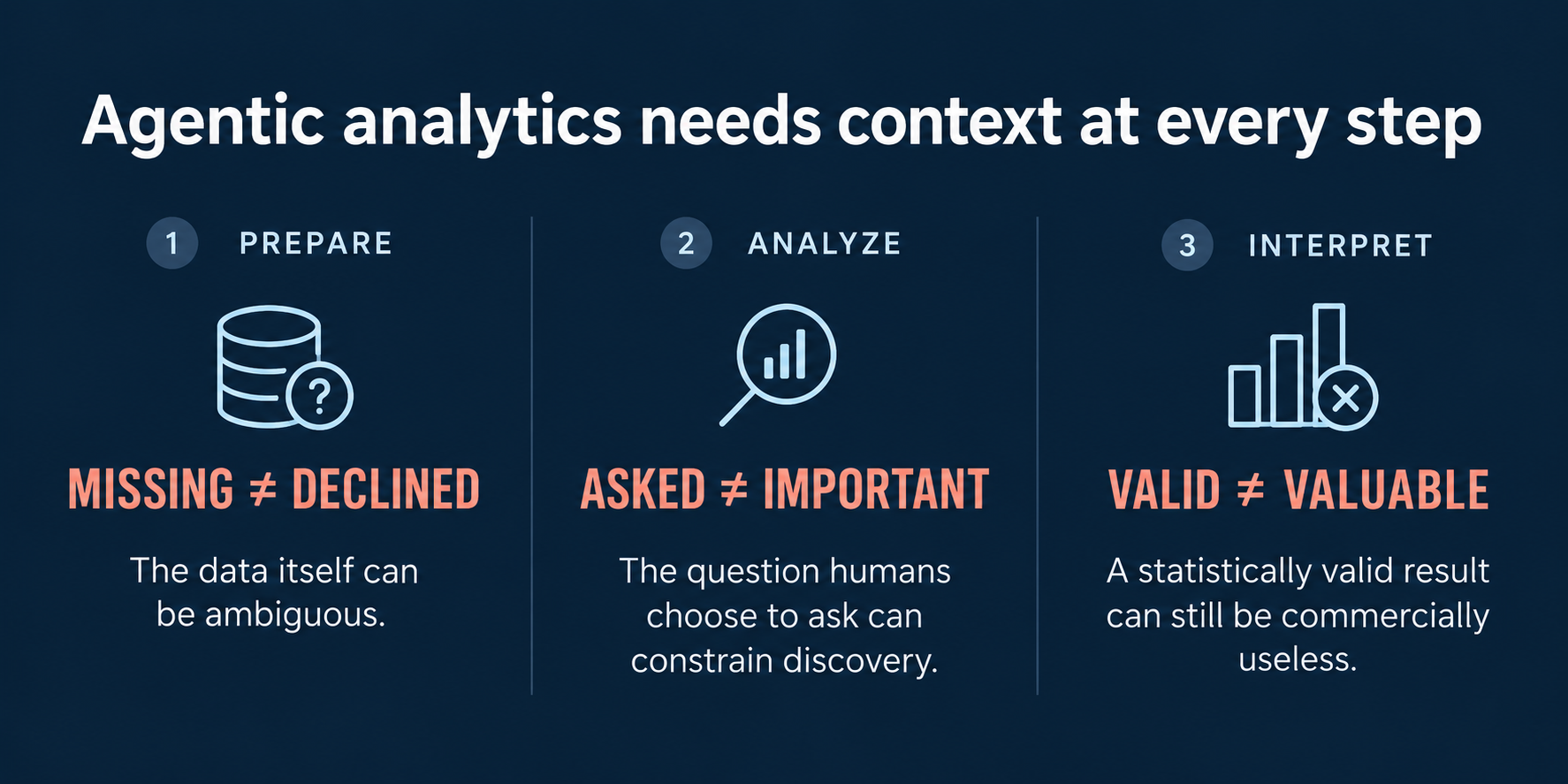
Preparing: The Analysis Starts Before the Model
Consider an airline looking for ways to increase revenue from frequent travelers. Its customer data may include booking history, loyalty status, route, fare class, upgrade behavior, ancillary purchases and hundreds of other variables.
Before an agent can search for opportunities, it has to decide what those variables mean analytically. Should travel frequency be measured over three months or twelve? Should two routes be treated similarly? Does a missing upgrade record mean the passenger declined an offer or never received one? Which raw fields should be combined to describe something meaningful about customer behavior?
A general-purpose LLM can write the code to prepare the data. The harder task is knowing which choices make sense for the airline. Data preparation already contains assumptions about the business, whether they are made by a person or an agent.
Klary treats this as part of the analytical problem rather than a mechanical preprocessing step. Its agents map data to business concepts, create features and combine signals from structured and unstructured information.
Analyzing: Finding a Pattern Is Not Enough
Agentic Analytics becomes particularly valuable when the system can search beyond a hypothesis someone has already defined. Rather than limiting the analysis to a question such as “Which passengers are most likely to buy an upgrade?”, the airline can ask where it is leaving revenue on the table and allow the agent to investigate.
Supervised learning approaches begin with a predefined target, such as an upgrade purchase, and often require choices about how success is measured over a fixed attribution window. Signals that emerge outside that window can be missed. Klary can also analyze without requiring a predefined target, allowing it to search more broadly for relationships and populations in the data.
There is a separate issue with conventional clustering. Methods such as K-means or DBSCAN can group customers according to geometric distance or density, but those groups are not necessarily meaningful business populations. Klary’s population-centric approach instead looks for statistically coherent, persistent sub-populations.
A general-purpose LLM can certainly code the model. It can also produce a convincing explanation of the resulting clusters. The harder part is determining whether it found the right population, whether the difference is stable, and whether the finding is worth acting on.
Interpreting: Business Context Can Change the Answer
Suppose the agent identifies frequent travelers who appear unusually receptive to premium upgrades. Statistically, the segment looks promising. But perhaps those passengers are concentrated on routes where premium cabins already run near capacity. Perhaps many travel under corporate policies that restrict upgrades. Or perhaps a recent pricing change means historical behavior is no longer a useful guide.
The pattern has not disappeared. Its business value has.
That is the problem with interpretation in Agentic Analytics. An agent may find a statistically valid relationship, but the business still needs to understand whether the result reflects a real commercial opportunity, a temporary effect, or something the model simply does not know about.
Interpretation becomes more important as agents gain autonomy. A wrong conclusion is no longer necessarily the end of the process; it can become the basis for the next action the system takes. That broader risk is a well-known challenge in autonomous systems: when an agent misinterprets its operating environment, it can execute a cascade of unintended or counterproductive actions. The lesson for Agentic Analytics is clear: capability does not eliminate the need for context, boundaries, and validation.
For Klary, the answer is not to treat the output of a general-purpose model as sufficient on its own. Results are expressed through human-readable rules, with supporting evidence that allows the business to understand why a population was identified and decide whether the finding makes sense. The goal is not just explainability after the fact; it is to make the logic behind the analytical result visible and usable.
This extends the shift Klary has written about in From Metrics to Growth Segments, moving from monitoring metrics toward identifying which customer populations are driving them and what action should come next.
Context is not an extra layer added after the analysis. It affects how the data is prepared, what the system chooses to investigate, and how the result is interpreted. Agentic AI can cover far more analytical ground than a human team working manually. The value depends on whether that exploration remains grounded in the business question the company is actually trying to solve.