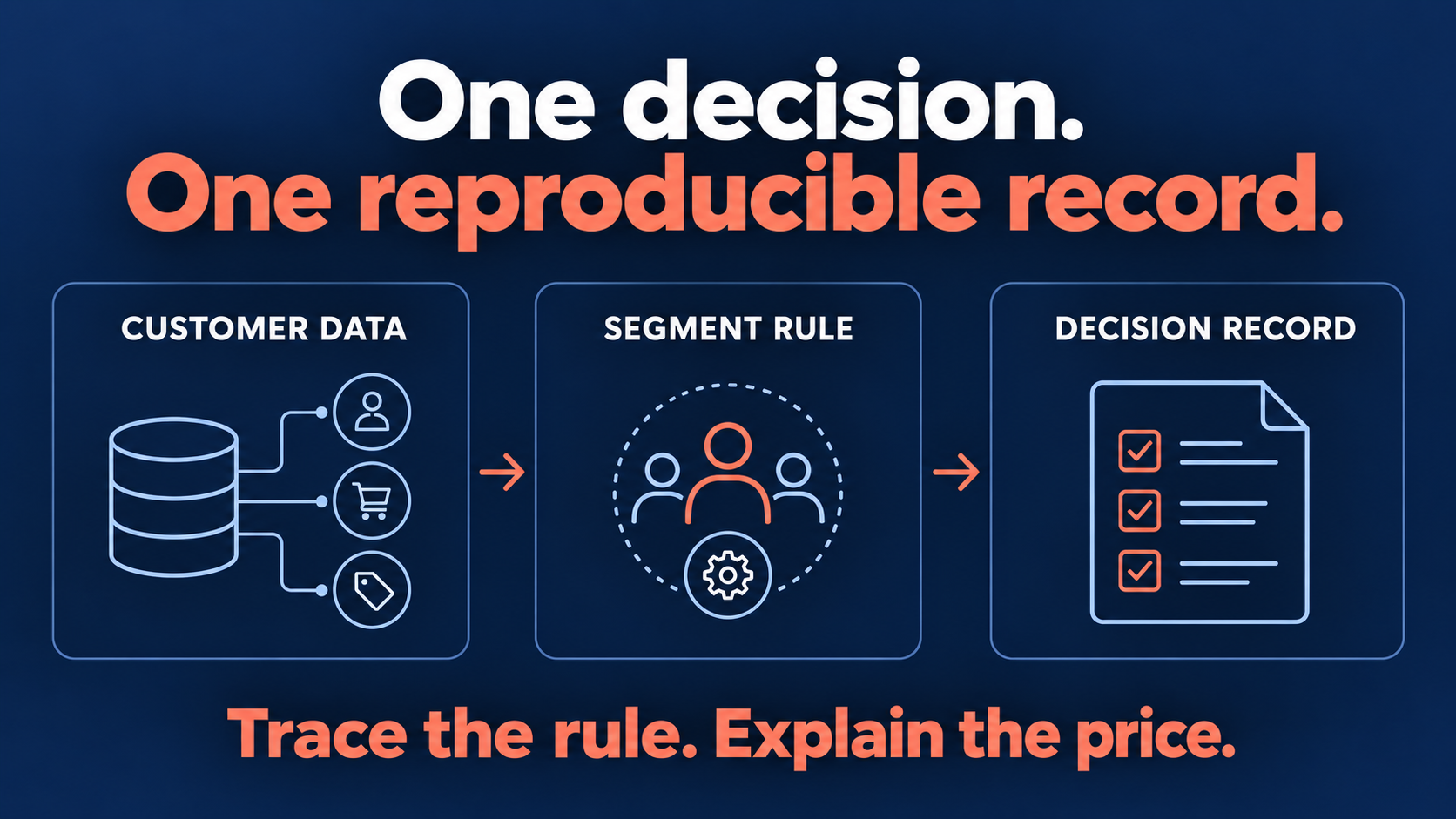
Personalized pricing is attracting closer regulatory attention as businesses gain access to more customer data and more sophisticated pricing models.
In August 2026, the Federal Trade Commission proposed an enforcement policy statement addressing the use of personal data to set individual prices. The FTC does not propose banning personalized pricing in all circumstances. Instead, where consumers reasonably expect a common price, the proposal focuses on whether businesses clearly disclose that a price is personalized, why it was personalized, and what types of data were used.
That creates a practical challenge for pricing systems that were built primarily for prediction and optimization rather than explanation.
What the FTC is asking businesses to explain
The proposal puts particular emphasis on three questions:
Was the price personalized?
Consumers should know when personal data, rather than ordinary market conditions such as supply and demand, affected the price they received.
What was the basis for the personalization?
It is not enough to say that an algorithm was used. The explanation needs to reflect the basis of the actual pricing decision.
What data was used?
The FTC proposal calls for disclosure of the types of data on which the personalization was based.
This becomes difficult when pricing relies on Machine Learning models, inferred variables or formulas containing many weighted factors. Post-hoc tools can help interpret a model, but the explanation they generate is separate from the mechanism that produced the price.
Where Deterministic Auto-Segmentation fits
Deterministic Auto-Segmentation, or DAS, takes a different approach.
DAS uses data to identify meaningful customer segments and then expresses those segments as explicit, interpretable rules. A segment might include customers with three or more purchases in the previous 12 months and an average basket value above a defined threshold. Everyone meeting the same rule receives the same associated price or offer.
The important distinction is that the rule is part of the production decision itself. The organization does not need to reconstruct the reason afterward. The same record can identify the rule, the data used, the treatment applied and the version in force at the time.
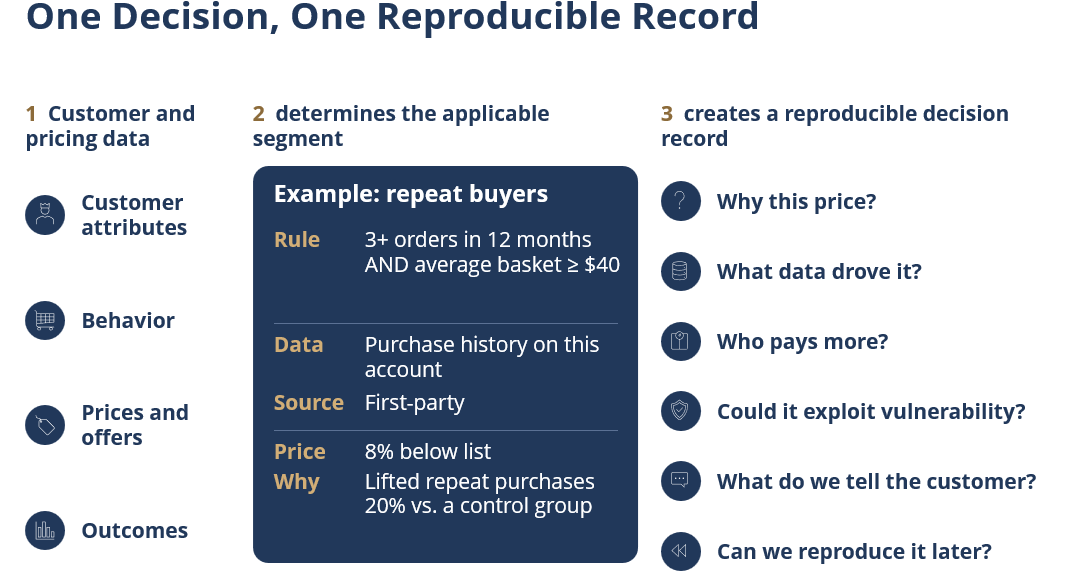
DAS can therefore be organized around five stages: Classify, Audit, Segment, Disclose and Govern. Together, they connect the data used for personalization to the rule that determines treatment and the explanation provided to the customer.
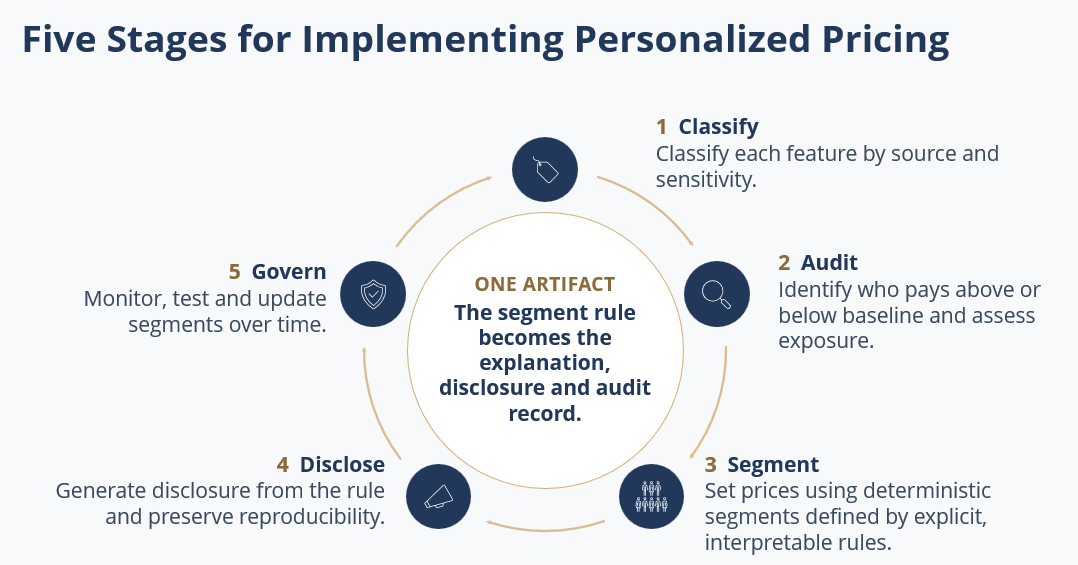
The objective is not to eliminate personalization, but to make the decision architecture more traceable, interpretable and reproducible.
Deterministic Auto-Segmentation does not determine whether a pricing practice is legally permissible or replace legal review. It provides a structured way to connect the data used, the rule applied, the treatment produced and the explanation given to the customer.